
Button Badge: The Complete Guide of Sizes and Materials
A box of 25mm badges arrives for a charity day, and they look tiny once someone pins one to a coat. The text is hard to read from a metre away.
The pin leaves marks on a shirt that was meant to stay neat and nobody asked for a magnetic back because nobody knew it was an option. The print is fine. The choice behind it just was not thought through.
These problems usually come down to two things, the size and what the badge is made of. Both are easy to get right once you know the options so this guide goes through them before you order custom badges for your own event or team.
What a Button Badge Is and Where It Gets Used
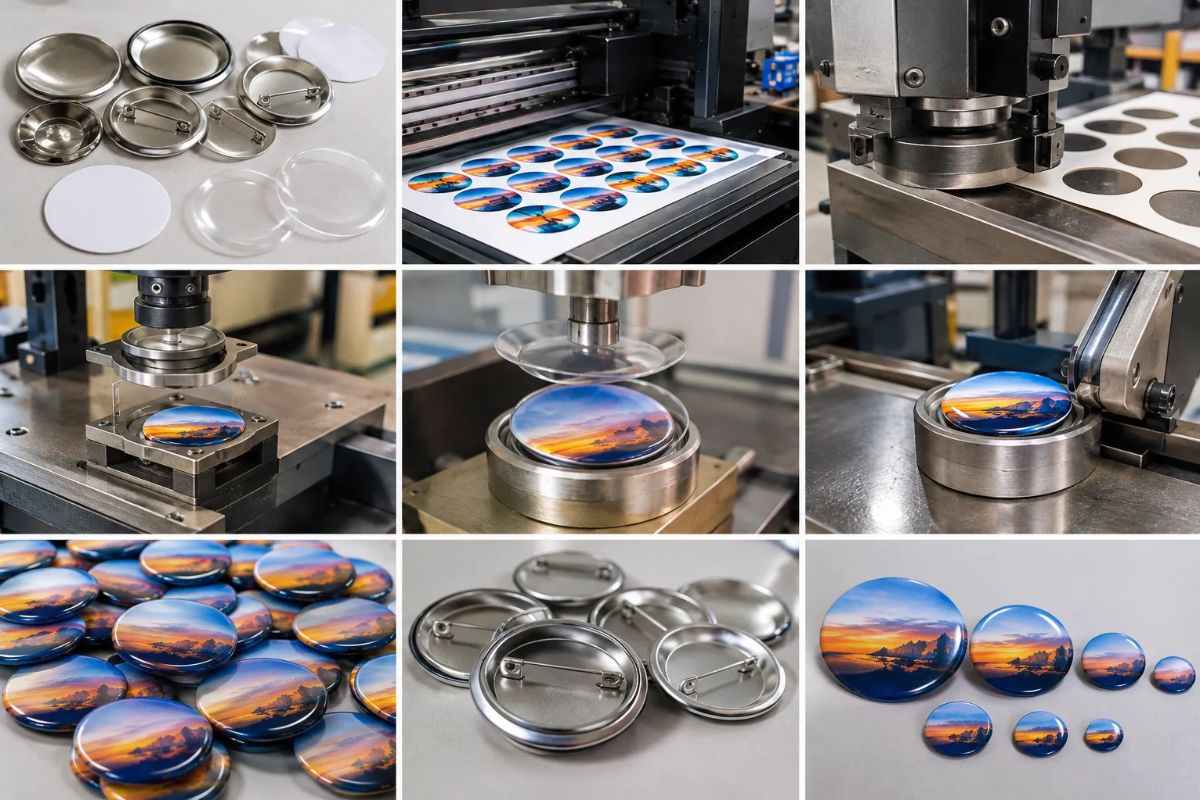
A button badge is a printed design pressed between a metal shell and a clear plastic cover with a backing piece fitted on the back. The artwork is usually printed on paper so it can be full colour and quite detailed. The clear film on top protects the print from scratches and damp.
In the UK you will see them in a few familiar places:
- Charity days and fundraisers
- School events, prizes and leavers’ days
- Campaigns and local elections
- Staff or team badges at shops, conferences and workplaces
- Gig and festival merchandise
They are different from stitched or moulded badges, which are made from thread or soft plastic and come up later in this guide. A button badge is flat and light so it suits short events and large handouts.
Button Badge Sizes and What Each One Suits
Button badges come in a handful of standard sizes and the right one depends on how far away someone will be when they read it. UK suppliers commonly list 25, 32, 38, 45, 55 or 58, and 75mm, though the exact range changes from one supplier to the next.
| Size | Where it works |
| 25mm | Band merch, small logos, collector badges |
| 32 to 38mm | Name badges, charity days, school rewards |
| 45mm | Team badges, staff badges, logos with a short name |
| 55 or 58mm | Campaigns, events, party badges, slogans read from a distance |
| 75mm | Photo badges, display pieces, large designs |
Smaller sizes suit everyday wear
A 25mm badge sits well on a bag strap or a denim jacket but it holds only a simple logo or a few short letters. The 32 to 38mm range has room for a name or a short message and it does not look heavy on a jumper. This is the range for school rewards and charity days.
Larger sizes suit events and display
A 58mm badge carries a slogan that people can read from across a room. This is the reason why campaigns and events use it. At 75mm there is space for a photo, though it suits display more than daily wear. A 45mm badge sits between the two and works for staff or team badges with a short name. If you order custom badges for a mixed group, such as staff and visitors at the same event, two sizes can work better than one.
Artwork needs extra space
The print has to be larger than the visible circle so the paper can wrap behind the metal shell. Each supplier has a template with the exact measurements so use it instead of designing to the badge diameter.
What a Button Badge Is Made Of
A button badge is built from four parts, and each one affects how it looks and how it is worn. Once you know them, a supplier’s product page is much easier to read.
The four layers
- Metal front shell: a thin curved disc that gives the badge its shape and holds the edge of the paper.
- Printed artwork: a paper print cut slightly larger than the visible face so it can fold around the edge of the shell.
- Clear protective film: a thin plastic layer over the print that guards it against scratches and damp.
- Backing piece: a plastic or metal back that locks everything in place and carries the pin, magnet or clip.
Backing options
- Safety pin: the standard choice. It holds well on bags, jackets and jumpers but leaves a small hole in thin fabric.
- Magnetic: no hole in the fabric, which suits staff in shirts or formal wear.
- Clip: goes on and off quickly, so it works for visitor passes and lanyards.
- Specialty: bottle opener, mirror or stand backs, mostly for gifts and giveaways.
The right backing depends on how often the badge gets worn. A giveaway badge is fine on a pin, while one that staff wear every day is better on a magnet or clip.
Gloss or matte cover
Gloss is the standard finish and it makes colours look stronger and brighter. Matte has a softer look and cuts glare, which helps when the badge is read outdoors or under bright event lights. Ask for a sample of both before placing an order for custom badges, since colour looks different in hand than it does on a screen.
How Embroidered and PVC Badges Differ From Button Badges
Button badges are printed, custom embroidered badges are stitched and PVC badges are moulded and that changes how each one looks, feels and attaches.
| Button | Embroidered | PVC | |
| How it is made | Printed paper under clear film on a metal shell | Thread stitched onto a twill base | Soft plastic formed in a mould |
| Feel | Flat and light | Textured and soft | Raised and rubbery |
| Best for | Events, handouts, short-term use | Uniforms, clubs, teams | Outdoor gear, bold logos |
| Attachment | Pin, magnet, clip | Sew-on, hook-and-loop | Often hook-and-loop or sew-on |
Button badges stay flat and light
They are the easy choice when you need many badges for a single day, such as a fundraiser or a conference.
Embroidered badges are stitched
The thread builds up a raised, textured surface so you see it on school blazers, club jackets and work uniforms. It is normally sewn on or fixed with hook-and-loop so it stays on a garment for a long time and is not something a visitor clips on for an afternoon.
PVC badges are moulded
Custom PVC Badges are formed in a mould from soft plastic, which makes them waterproof and easy to wipe clean. They can be flat with raised edges or moulded in 3D so they suit bold logos and gear that gets wet or muddy, like bags and jackets. If you are weighing PVC against stitched badges, think about where the badge will be worn and how often it will be out in the rain.
How to Choose the Right Size and Material
Start with where the badge will be used, then work backwards to the size, the backing and the type.
- Decide where it will be worn and for how long: A badge for one afternoon at a school fair has different needs from one a staff member wears every shift.
- Pick a size by reading distance: If people only see it up close, a 25 or 32mm badge is enough. If they need to read it from across a room, go to 58mm.
- Pick a backing: A pin is fine for giveaways. Magnetic or clip suits staff in shirts or anyone who wears the badge often.
- Pick the build: Button badges suit short-term and large handouts. Embroidered suits uniforms and clubs. PVC suits bags and outdoor gear.
- Check the artwork and template with the supplier: Send your design and ask what size and file type they want, and request a digital proof before they produce your custom badges. A name that sits too close to the edge is easy to catch at this stage and hard to fix after printing.
If two options seem close, order a small sample batch first. You get a clear idea when the badge is in your hands rather than looking it in an image or on the website.
Frequently Asked Questions
What size button badge should I choose?
It depends on how far away the badge will be read. 25mm suits small logos, 32 to 38mm suits names and short messages, 58mm suits slogans at events, and 75mm suits photos or display. UK suppliers differ on the exact sizes they offer, so check the list first.
What are button badges made of?
A metal front shell, a printed paper design, a clear protective film and a backing piece. The backing carries the pin, magnet or clip, and the film protects the print from scratches.
Should I choose a pin or a magnetic backing?
A pin is the standard backing and suits giveaways, bags and jackets. A magnetic backing leaves no hole in the fabric so it suits staff who wear the badge often in shirts or formal wear.
What is the difference between embroidered and PVC badges?
Embroidered badges are stitched from thread so they have a soft, textured look and suit uniforms and clubs. PVC badges are moulded from soft plastic, so they are waterproof, easy to wipe clean and suit bags and outdoor gear.
Are button badges waterproof?
The clear film protects the print from scratches and light damp. A badge that gets soaked often can still be damaged, so for wet or outdoor use a PVC badge is the safer choice.
Final Thoughts
A badge is a small thing but people do read it. It sits on a coat, a lanyard or a bag and someone looks at it on a train, in a queue or across a table at an event.
That is why the size and the build deserve a few minutes before an order goes in. Picturing where the badge will be worn and who will read it, settles a lot of the questions.
Anything left open can be sorted out with a supplier, who can look at the design and say what will work.

Meet Ryan, the most creative and passionate craftsman at CustomBadges.uk. He knows which type of badge works best for which garment. Whether you want customization guidance, tips for the application, or any other relevant information about badge making, Ryan will share some extremely valuable insights with you. His knowledge is way more than just an ordinary badge maker.